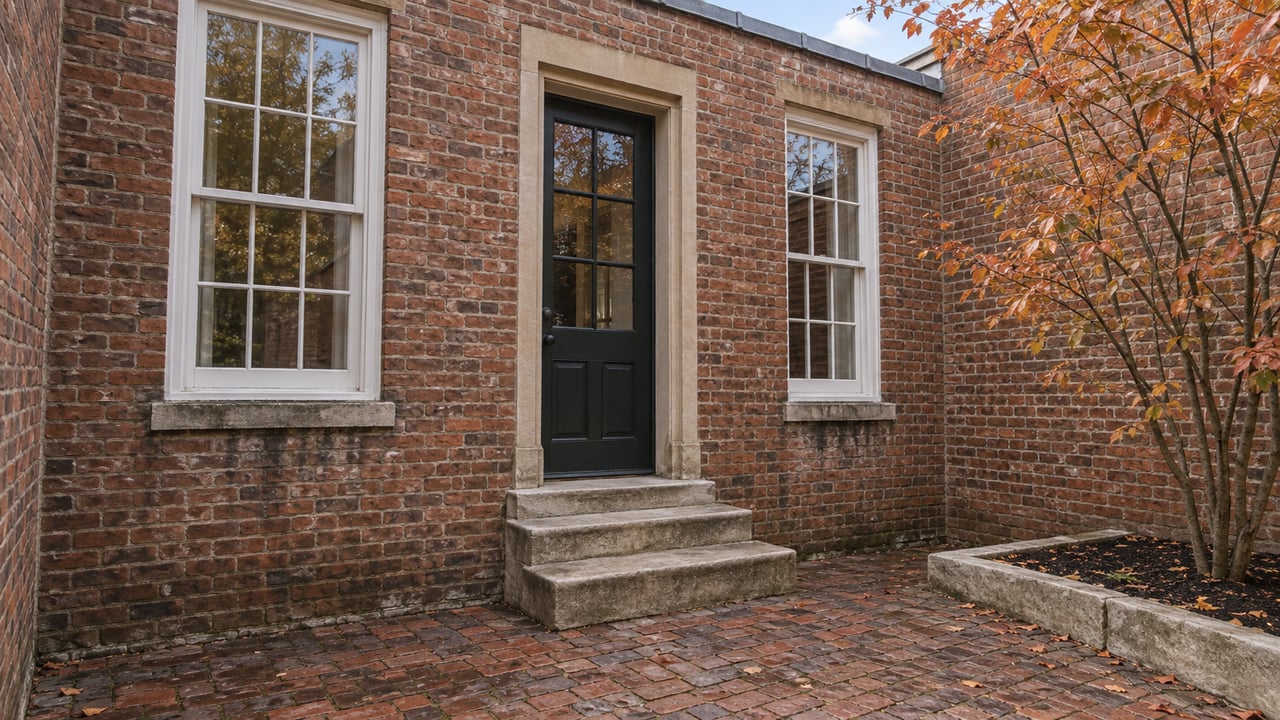
"This wasn't a restaurant before, but we worked really hard to make this place feel like it had been here for 40 or 50 years." That's chef Alex McCoy, describing Alfie's, the northern Thai restaurant and natural wine bar he opened with Justin Ahn on September 2 in the alley section of Hamilton Collective at 1228½ 31st Street NW. Twelve days later, Flora Pizzeria opened next door, working a natural leaven and Sicilian sea salt into its dough.
Neither restaurant faces a street you'd walk down by accident. You have to know the alley exists.
Meanwhile, four blocks away on M Street, Uniqlo opened its Georgetown flagship on August 28 with Japanese taiko drummers and 22,618 square feet of retail floor, the kind of opening that photographs well and needs no alley to find. Both things happened within the same three weeks. Only one of them required directions.
That split is the actual story of Georgetown this fall. The neighborhood isn't having one wave of openings. It's having two, in two different kinds of space, and they don't share foot traffic. If you've only been tracking what's visible from the sidewalk on M Street or Wisconsin Avenue, you've seen half of what changed.
The Alley Learned to Cook
Hamilton Collective's alley entrance off 31st Street has quietly become a small restaurant row. Alfie's and Flora Pizzeria anchor one end. In the same building, Skillette, a cooking school that started as a pop-up in La Cosecha food hall, is building out its own 1,525-square-foot teaching kitchen alongside Bizzeria, giving the alley a third identity beyond dinner service. None of this required a marquee address. It required a landlord willing to lease alley-facing space to people willing to gut it.
McCoy's comment about making a raw space feel decades old gets at something specific to how Georgetown absorbs new restaurants now. The neighborhood has very little available street-level retail left on its primary corridors. What it has instead are second-floor spaces, courtyards, and alleys that were never zoned for dining in the first place, now getting converted because that's where the square footage is. A resident who wants to know what's actually new in the neighborhood this fall has to be willing to turn down a passage that doesn't look like it leads anywhere.
What M Street Kept and What It Gave Up
M Street's own changes this season run in the opposite direction, toward scale rather than concealment. Uniqlo's flagship, at 3262 M Street NW, is built for volume. A few blocks over, at 3287½ M Street NW, in the space that used to hold Harmony Café, the Northern Virginia food truck Flavor Hive built its first storefront kitchen, offering samples to passersby the week it opened. Same street, same commercial spine, two entirely different scales of ambition. M Street in 2026 can support both a global apparel flagship and a food truck's first real address, which tells you the corridor isn't consolidating around one kind of tenant. It's holding room for both.
Off M Street, on the side streets that feed it, two more openings extend the pattern of activity happening just out of direct sightline. Café Tulúm joined the Grace Street Collective at 3210 Grace Street NW last month, bringing Yucatán-inspired flavor to a courtyard address most people only find because they were already headed somewhere else in the collective. And on O Street, at 3213 O Street NW, O Street Collection soft-opened as a new art boutique during Art All Night, showing more than 50 original works from over 10 contemporary artists, priced from $50 into five figures. The building has its own layered history: it once housed the law office of Max N. Berry, himself a significant art collector, and before that, a café. A gallery now occupying a former law office that itself replaced a café is the kind of small civic detail that only shows up if you're paying attention to what a specific address has been over time, not just what it is this month.
The Calendar Doesn't Care What's New
None of this retail churn touches the two fixed points on Georgetown's fall calendar, and that's worth sitting with for a second. The Georgetown Fall Market returns to Book Hill and Wisconsin Avenue, from N Street to Reservoir Road, on October 17 and 18, following the same format it has run in past years: sidewalk sales from small businesses, fall-inspired menus, and a stretch of pedestrianized Wisconsin Avenue that turns Book Hill into a two-day festival. Past editions have paired the market with a Georgetown Library Friends book sale at the foot of Book Hill Park, with proceeds supporting the library, and with Tudor Place Foundation setting up alongside the vendors. None of that depends on which restaurant opened last month. It happens on Book Hill because Book Hill has hosted it for years, independent of what's turning over closer to the water.
Down at the other end of the neighborhood, Georgetown Waterfront Park closes out a different kind of season this week. Dancing on the Waterfront, the free Tuesday-night dance series the Georgetown Business Improvement District has run since June, was extended past its original end date and wraps its final session on September 29, the day after this piece publishes. Salsa, bachata, square dancing, and kizomba, with a different DJ each week and the Potomac as the backdrop, the kind of programming that only works because a park built for quiet contemplation also has room for a crowd on a summer evening. Its last Tuesday and the alley's newest tables are running at the same time, in parts of the neighborhood that don't overlap on a map.
Reading the Season as a Whole
Put together, the fall reset in Georgetown looks less like one trend and more like three neighborhoods layered on top of each other. M Street holds the flagships and the food trucks. The alleys and side courtyards behind 31st, Grace, and O Streets hold the smaller, harder-to-find openings that reward people willing to walk past a storefront and check what's behind it. And Book Hill and the Waterfront hold the calendar, the parts of Georgetown that don't turn over with a lease.
A resident trying to actually see the season rather than read about it later has a short list of specific stops, not a single walk down one street:
- Turn off 31st Street into the Hamilton Collective alley for Alfie's or Flora Pizzeria, and check whether Skillette has posted its first class schedule
- Walk O Street to see what O Street Collection has hung this month, then cut down to Grace Street Collective for Café Tulúm
- Compare Uniqlo's scale to Flavor Hive's storefront, four blocks apart on the same stretch of M Street
- Block out October 17 and 18 for the Book Hill Fall Market before the Tuesday dance series at the Waterfront wraps for the year on September 29
None of these stops depend on each other, and none of them is more "real" than the others. The point isn't that the alley matters more than M Street or that Book Hill matters more than either. It's that a neighborhood this compact can still hide half its own season from someone who only walks the obvious streets.
Michael Rankin has spent more than three decades watching Georgetown absorb change one building at a time, from a law office that became an art gallery to an alley that became a restaurant row. If a specific address in the neighborhood has you curious about what it used to be, or what it might become, Michael Rankin is a good person to ask.