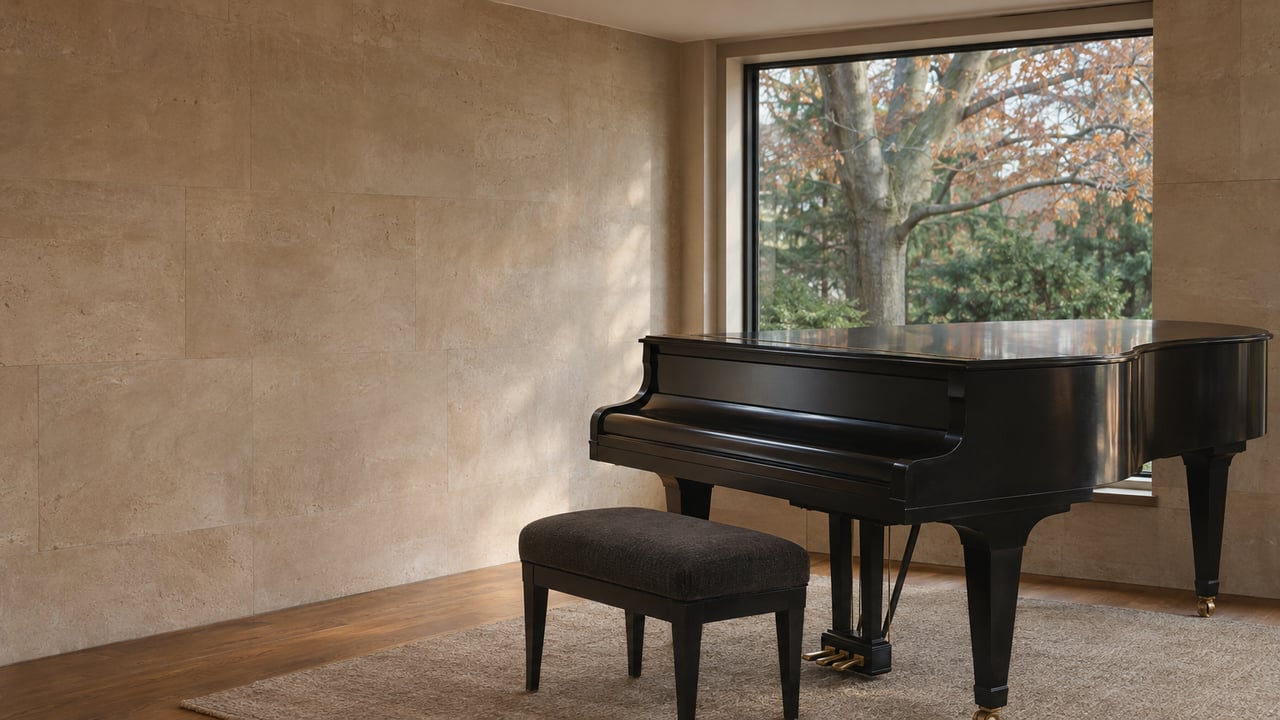
The walls of the Kreeger Museum's galleries are covered in beige cotton carpet. It was woven in Georgia, and the museum says it has three jobs. It softens the hard lines of the travertine and anodized aluminum, it makes it easy to move artwork from one spot to another, and it improves the acoustics. In the Great Hall, the lunette windows are filled with cork, which filters the light and also improves the acoustics.
A house that tunes its walls was designed for sound. Between now and the end of December, the Kreeger's calendar fills that room more often than at any other point in the season, with a solo cellist, two jazz shows, a holiday concert and a run of talks. The exhibition upstairs, Out of Bounds, hangs in rooms built to carry sound.
Four requirements, and one of them was a recital hall
Philip Johnson and Richard Foster designed the house in 1963 for David and Carmen Kreeger. The museum's architecture page lists the couple's four requirements: space for their collection of 19th- and 20th-century paintings and sculpture, "a large recital hall for music," private living spaces with views and light, and family recreation areas that included a pool and tennis courts.
The design came out of those requirements. The building sits on five and a half wooded acres and covers about 24,000 square feet. It is built of poured concrete clad in travertine on a grid of 22-by-22-foot modules, with 17 domes in all. Three of those domes are sail domes over the Great Hall. Foster went to Italy himself to choose the travertine, and the Kreegers moved in in August 1967. In 1994, when the house was about to open as a museum, The Washington Post described David Lloyd Kreeger as an "insurance magnate, philanthropist, fiddler and art lover." The paper described the 66-foot-long Great Hall as built "for chamber concerts."
His insurance career was at GEICO. The Georgetowner notes that he advised the company and found investors for it before becoming its chairman and CEO, and that the museum opened to the public in 1994. Foster wrote to the museum that same year, and the museum quotes his letter. He called the building "a special monument to David and Carmen Kreeger – to their love of art and music."
The museum says little has changed since 1967. The pool became a reflecting pool in 2011, the tennis court on the north lawn was removed in 2013, and a glass roof replaced the plexiglass atrium dome in 2007. The room for music is as it was built. The DC Office of Planning's Ward 3 Heritage Guide lists the Kreeger House and Museum as eligible for historic listing.
What hangs in those rooms through December
Out of Bounds opened October 15. It shows work by seven alumni of Hamiltonian Artists: Selin Balci, Larry W. Cook, Joyce Yu-Jean Lee, Christie Neptune, Allison Spence, Kyle Tata and Jing (Ellen) Xu. Anisa Olufemi curated it. She is director of programs and curator at Hamiltonian Artists. The show belongs to The Collaborative, a program the Kreeger started in 2021 to support Washington-area artists.
The title comes from sports, where "out of bounds" means the space past the edge of play. The artists work in painting, photography, sculpture, video and installation, and the exhibition page says they "consider what it means to question, cross, or redraw established boundaries." Their work hangs next to selected pieces from the Kreeger's own collection by Sam Gilliam, Frank Stella, Simmie Knox and William Christenberry. The museum calls each of these four "an iconoclast in their day."
The pairing suits the house. Johnson and Foster designed a home that was meant to become a museum and to hold concerts, and Foster's letter refers to "the long-range vision that this home would eventually be a museum." Many of the season's programs are timed to send concert and talk audiences through the galleries first. The December 5 talk page asks guests to arrive early to see the galleries, and the jazz ticket includes admission to the galleries and the sculpture garden. The exhibition runs through the end of December.
The calendar from publication day to the holiday shows
The curator-and-artists conversation on November 14 has passed. Here is what remains as of November 19.
| Date | Program | Setting | Ticket |
|---|---|---|---|
| Thu., Nov. 19, 7 p.m. | Amarilis Dueñas Castán, solo cello | Great Hall | $25 |
| Sat., Nov. 21, 10 a.m. | Yoga in the Sculpture Garden | Sculpture garden | $25, or $40 with admission |
| Sat., Nov. 21, 3 p.m. | Jazz at The Kreeger, EJB & Standard•Ish | Museum | $35, includes galleries and garden |
| Sat., Dec. 5, 4 p.m. | Nekisha Durrett and Virginia Shore in Conversation | Museum | $25, includes admission |
| Sat., Dec. 12, 10 a.m. | Meditation in the Galleries | Galleries | See museum calendar |
| Mon., Dec. 14, 11 a.m. | Conversations at The Kreeger Museum | Museum | See museum calendar |
| Thu., Dec. 17, 7 p.m. | Heifetz Holiday Concert | Museum | $40; members $35 |
| Sat., Dec. 19 | EJB Holiday Show, featuring the Tim Brey Trio | Museum | See museum calendar |
Two of these concerts use the Great Hall the way the Post described it in 1994. Amarilis Dueñas Castán's cello recital is tonight, the day this post publishes. Doors open at 6 p.m. and the music starts at 7 in the Great Hall. Her program puts solo-cello works by Dall'Abaco, Bach and Gabrielli into three sections titled "Zolmat," "Chhaya" and "Komorebi." One player with one instrument is the scale of performance the cork lunettes and carpeted walls were built for.
The Heifetz Holiday Concert on December 17 follows the same timing, with doors at 6 p.m. and the concert at 7. The museum lists the performers as young alumni of the Heifetz International Music Institute. Two days later, on Saturday, December 19, Jazz at The Kreeger has its EJB Holiday Show, featuring the Tim Brey Trio.
The talks are tied to the exhibition. On December 5, artist Nekisha Durrett and Virginia Shore will speak for an hour starting at 4 p.m. The museum asks guests to arrive early enough to see the galleries before the talk begins.
November 21 fills the house from the garden to the hall
The Saturday before Thanksgiving is the one day this season when programs run in the garden in the morning and inside in the afternoon.
At 10 a.m., Jeneen Piccuirro leads a one-hour, all-levels yoga class in the sculpture garden. The garden's outdoor collection includes Jean Arp's Hurlou, Henry Moore's Three Piece Reclining Figure No. 2: Bridge Prop and Isamu Noguchi's Soliloquy. The museum's collection records mark all three as on view. When the house opened in 1994, the Post listed Moore among the sculptors in the collection, along with Jacques Lipchitz, David Smith and Aristide Maillol.
At 3 p.m., saxophonist Elijah Jamal Balbed brings EJB & Standard•Ish to the museum. The quintet is Balbed on saxophones and arrangements, Andrew Tinch on guitar, Minh Vo on piano, Tyson Femister on upright bass and Stefan Schatz on drums. A $35 ticket also covers the galleries and the sculpture garden. With the regular galleries closing at 4 p.m., a jazz ticket is the simplest way to see Out of Bounds, walk the terrace and hear a full band in the Great Hall on the same day.
Practical details for a visit
The museum's regular schedule is short, so plan around it.
- Days and hours. The museum is open Tuesday through Saturday from 10 a.m. to 4 p.m. The grounds close at 4:15 p.m., and the museum is closed Sundays and Mondays. The December 14 program falls on a Monday, so it is the exception to that schedule.
- Admission. Adults pay $15. Students and educators with ID, seniors 62 and older, and military visitors pay $10. Members and visitors 18 and under get in free.
- Parking. The museum lot has a two-hour limit, and there is additional accessible parking in the forecourt. Two hours covers a concert but not much browsing on either side of it.
- Groups. Parties of more than 15 should email the museum ahead to reserve.
- The garden. The paved parts of the garden are reached through the Garden Gate in the forecourt.
- Seating for talks. The museum encourages registering early for its conversation programs because seating is limited.
The museum is at 2401 Foxhall Road NW, on the same five and a half acres the Kreegers moved onto in 1967. The cello recital tonight and the Heifetz alumni on December 17 are the two chances left this year to hear the Great Hall used as a chamber-music room.
A house built around a recital hall is the kind of provenance Michael Rankin pays close attention to. If you own a residence designed with a specific purpose in mind, or would like to find one, he would be glad to talk with you about it. Book an Appointment.