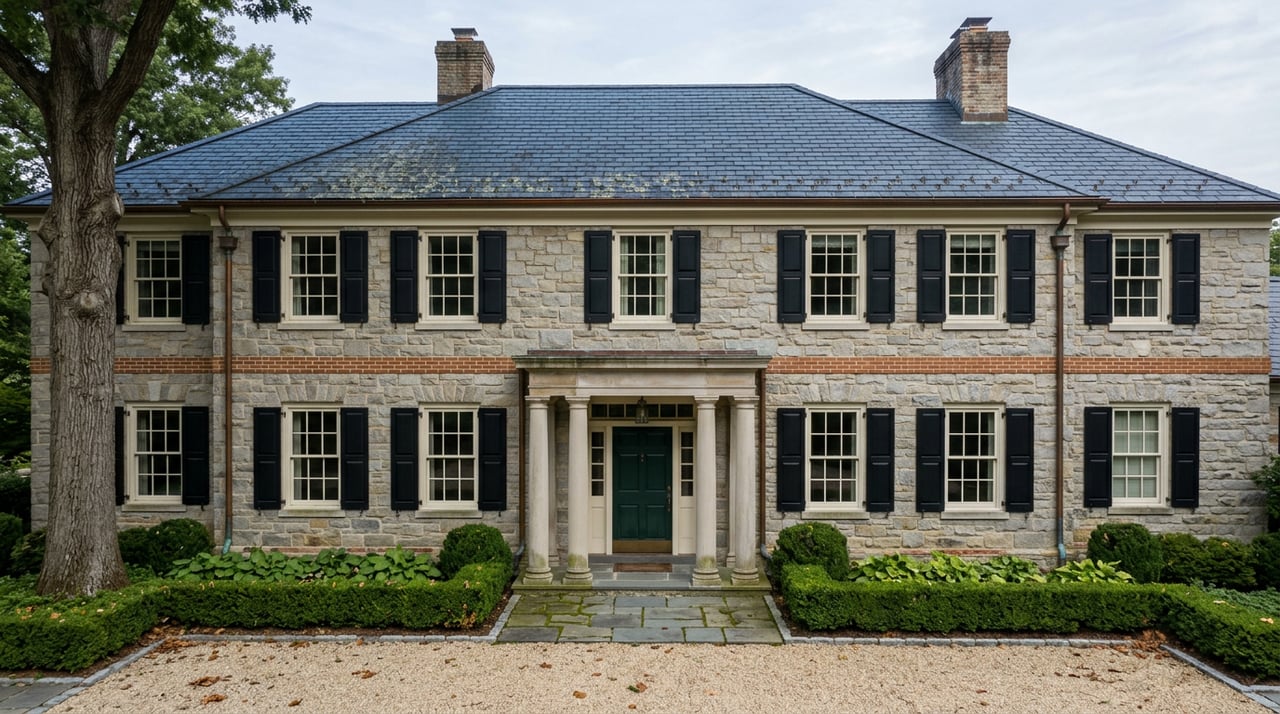
A buyer comparing two listings this spring, both marketed simply as "Chevy Chase, Maryland," assumed the tax picture would be roughly the same. Same zip code cluster, same school catchment conversation, same leafy blocks off Connecticut Avenue. It wasn't until the settlement sheets came back that the difference showed up: one address carried a municipal property tax layer the other didn't, because the two houses sat in different incorporated towns that happen to share a name.
That surprise is not a fluke of paperwork. It's the plainest evidence of something buyers moving through this part of Northwest Washington and Montgomery County routinely miss: Chevy Chase is not one market. It is a shared name stretched across at least seven separate local governments, each setting its own rules, and the traffic circle where Connecticut Avenue crosses the District line is the only thing that visually holds them together.
Understanding that structure matters more than it sounds like it should, because this year the two sides of the line aren't just governed differently. They're moving in opposite directions.
Six Names, Six Governments, One Circle
Cross Western Avenue from the District into Maryland and "Chevy Chase" stops being a single place in any legal sense. Chevy Chase Village, the Town of Chevy Chase, Section 3, Section 5, and North Chevy Chase are each their own incorporated municipality, layered on top of the same Montgomery County and Maryland state tax base but empowered to set their own additional levy and their own budget priorities. A resident of Chevy Chase Village answers to a Board of Managers. A resident two blocks away in the Town of Chevy Chase answers to a Town Council. Neither one answers to the other, and neither one answers to whatever civic body governs the third neighbor over.
The differences go beyond the rate on the bill. Chevy Chase Village's FY2026 budget work session set its proposed real property tax rate at $0.0636 per $100 of assessed value, funding roughly $948,000 in village revenue for the year, according to the Village's own February 2026 budget documents. Section 5, by contrast, leans on an entirely different funding mechanism: municipalities in Maryland receive a 17 percent share of each resident's state income tax, and Section 5's own May 2026 annual meeting packet projects at least $1,000,000 in income tax revenue for the year, a figure the council treats as more variable and harder to forecast than a fixed property levy. Section 3 sets a separate municipal property rate of its own, distinct again from both.
Government you deal with | Property tax layer | Who sets it | |
|---|---|---|---|
Chevy Chase, DC | District of Columbia | One flat citywide rate | DC Council |
Chevy Chase Village, MD | Village Board of Managers | Village rate, proposed at $0.0636/$100 for FY2026 | Village budget process |
Town of Chevy Chase, MD | Town Council | Separate town rate, set annually by ordinance | Town Council |
Section 5, MD | Section 5 Council | Funded largely by a 17% share of resident income tax, not a large property levy | Section 5 budget process |
On the District side of Western Avenue, there is no equivalent patchwork. Every property in Chevy Chase, DC pays into the same government, under the same flat residential rate the rest of the city uses, set once by the DC Council rather than negotiated separately by six or seven small boards. A buyer comparing a DC address to a Maryland one isn't just comparing two houses. They're comparing a single government to a cluster of them, and assuming the math works the same way on both sides is where the settlement-sheet surprises come from.
Two Time Windows, Two Directions
The governance gap would be an interesting footnote on its own. What makes it worth a buyer's attention right now is that the two sides of the line are also pricing differently, in the same three-month window this spring.
On the DC side, the median sale price over the three months ending in May 2026 ran about $1.5 million, up roughly 2 percent from the same period a year earlier, with homes moving in an average of about 17 days. On the Maryland side, over that identical three-month window, the median sale price came in closer to $1.3 million, down more than 9 percent year over year, with the average time on market nearly tripling, from about 7 days a year ago to about 19 days this spring.
That's not a rounding difference. It's two markets, sharing a name and a zip-code neighborhood, moving in opposite directions during the exact same stretch of the calendar.
It would be easy to chalk that up to noise, and some of it probably is. Smaller pockets within Chevy Chase, DC show the kind of swings you'd expect from thin sample sizes, not fundamentals: a handful of sales in one sub-area can move a median by double digits in either direction from month to month. That volatility is real, and worth flagging before anyone treats a single month's number as gospel.
But the three-month trend on each full side of the line is wide enough, and consistent enough across the metrics, that it's worth asking what's actually different about how each side operates. The governance structure is the most concrete answer available.
What a Single Government Can Build
The clearest evidence sits at Chevy Chase's DC-side civic core. The Office of the Deputy Mayor for Planning and Economic Development held a disposition hearing in March 2025 and, this year, selected a developer, Rift Valley Chevy Chase LLC, to redevelop the Chevy Chase Civic Site: a modern library, a new community center, and 177 units of affordable and market-rate housing on land the District already owns. The project's development team hosted a community meeting on February 28, 2026, walking neighbors through design and programming.
That kind of project is only possible because a single government owns the land, runs the RFP, and answers to one set of elected officials. There is no equivalent civic parcel that "Chevy Chase, MD" as a whole could redevelop this way, because there is no single "Chevy Chase, MD" government to hold the land or run the process. Six or seven boards would each have to act on their own six or seven pieces of jurisdiction.
The same DC-side unity shows up in a fight that hasn't fully resolved. The Chevy Chase DC Conservancy filed an application in October 2023 to designate a large stretch of the neighborhood a historic district, arguing it was the strongest available tool to require design review on new construction. Neighbors were sharply divided. Historic Chevy Chase DC, a separate community history organization, argued the timing was more about slowing development near the civic core than about preservation on the merits. A group calling itself Living Chevy Chase organized against the nomination outright. In April 2024, the DC Historic Preservation Office said it wasn't prepared to recommend the proposal move forward, citing divided public sentiment and boundaries it found insufficiently justified. The Conservancy's own materials still describe a historic district as the neighborhood's best available protection, which means the question is shelved rather than settled.
What's notable isn't who's right. It's that the fight has one arena to happen in: one preservation office, one review board, one council. On the Maryland side, an equivalent disagreement, if it arose, would need to play out separately in each of six or seven small governments, each with its own process and its own timeline.
A market that can act through a single channel moves differently than one that can't, whether the action in question is building a library or blocking one.
What to Actually Check Before You Compare Two Listings
Before treating two "Chevy Chase" addresses as directly comparable, a few checks are worth making regardless of which side of the line you're on:
- Confirm which specific municipality or section a Maryland address sits in. County assessment records will show it, and it determines which budget, which council, and which tax layer actually applies.
- Ask for the full settlement-level tax estimate, not just the county's base rate, if you're comparing a Maryland property to a DC one.
- If the DC address falls inside the area the Conservancy proposed for historic designation, ask whether that status could resurface before you plan any exterior renovation.
- Look at what's actively being built or rezoned near the property. A civic project or corridor rezoning nearby can shift the character of a block faster than a school boundary or a listing description will tell you.
A Few Direct Questions
Does DC's single flat tax rate mean it's automatically cheaper than Maryland? Not necessarily. A flat rate means uniformity, not a lower number. What it buys is predictability: every DC property in the neighborhood is taxed under the same formula, set by one government, rather than a rate that depends on which of six or seven small jurisdictions a specific address happens to fall inside.
Is the Chevy Chase DC historic district proposal still active? It's paused rather than closed. The Historic Preservation Office declined to send the 2023 application to the full review board in 2024, but the Conservancy has not withdrawn its underlying goal, and the neighborhood remains divided on the question.
How do I find out which Maryland municipality or section a specific house is in? Montgomery County's property tax records identify the municipality tied to any address, and each municipality's own government website publishes its current budget and rate. That's the only reliable way to compare two Maryland listings that both say "Chevy Chase" on the sign.
None of this makes one side of Western Avenue a better buy than the other. It makes them different systems, currently moving at different speeds, for reasons that have as much to do with who can act as with what a house is actually worth. Comparing two addresses across that line without accounting for the government each one answers to is comparing the wrong thing.
If you're weighing a purchase on either side of Chevy Chase Circle, that's exactly the kind of local mechanics worth walking through before an offer goes in. Michael Rankin has spent decades working both sides of that line and can help you compare the two properly. Book an appointment to start the conversation.