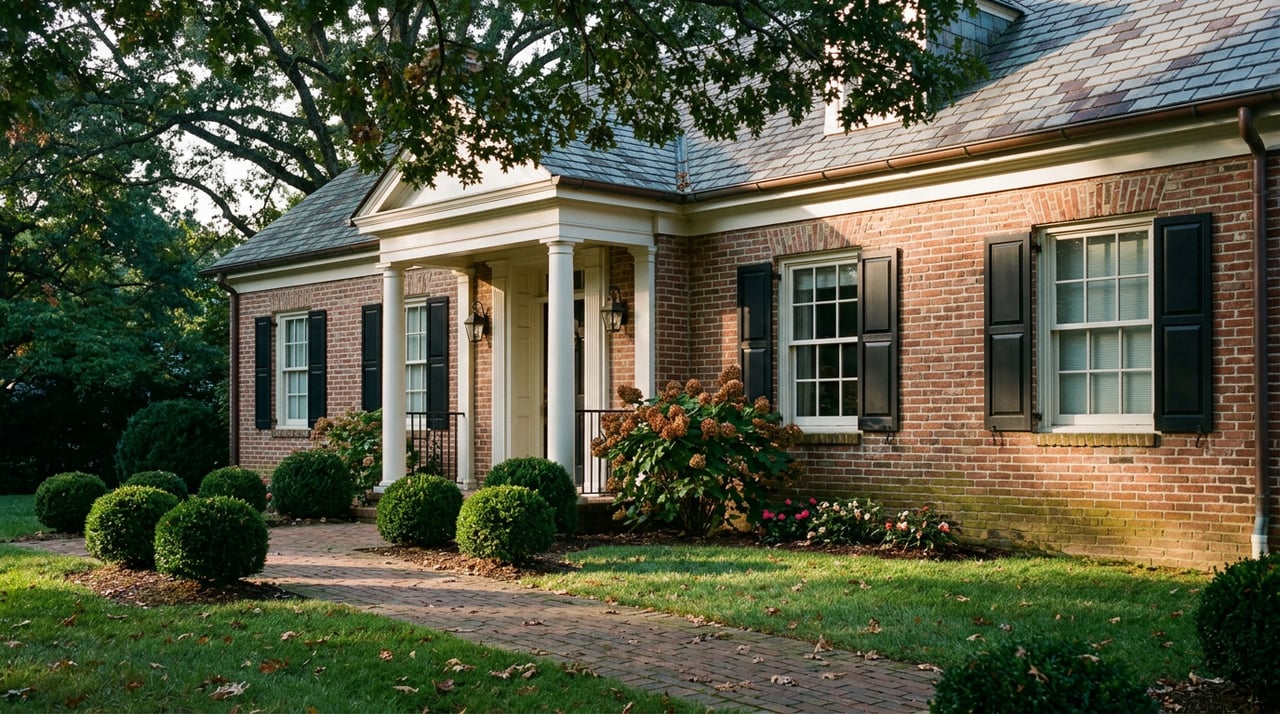
In late summer, two Spring Valley homes sold for the same price, four days apart on the calendar but worlds apart in how they got there. A circa-1930 Tudor listed at $4.5 million went under contract in four days and closed at $4.8 million to Samuel P. Boyd, founder of Confido Advice & Investments, and Christina I. Boyd. Around the same time, a renovated 1950s mansion listed at $4.895 million took 27 days to find its buyers, Isaac Flattau, founder of the AI media company B17GV, and Rebecca O'Brien, a global finance lawyer at Sidley. It also closed at $4.8 million.
Same neighborhood. Same price point, almost to the dollar. A gap of 23 days between them.
If you have been reading portal snapshots of Spring Valley this year, you have probably absorbed the phrase "buyer's market" without much resistance. Realtor.com's April 2026 data pegged the median listing at $2.65 million with a median of 26 days on market and called the neighborhood exactly that: buyer-friendly. Redfin's March figures told a similar story on paper, a $2.55 million median sale price and a 99.6 percent sale-to-list ratio, alongside an average of 29 days to go pending. Movoto's June read showed 47 days. Redfin's own luxury-tier page, tracking the $4 million and up segment specifically, put the figure at 57 days.
None of those numbers is wrong. All of them are describing an average of two markets that do not behave alike.
What the median is actually averaging
Spring Valley was built out after World War I by the firm of W.C. and A.N. Miller, and the housing stock still carries that layered history. Original-period homes, partially updated properties, and fully modernized residences sit on the same blocks, sometimes the same street. A single median days-on-market figure is quietly averaging a home that a buyer can move into tomorrow with one that a buyer is mentally pricing out a kitchen renovation for while standing in the foyer.
The Boyd sale is the fast half of that average. The Flattau and O'Brien sale, on a renovated 1950s mansion that still took 27 days despite being updated, shows that even renovation does not guarantee a four-day close. It reduces the range of outcomes. It does not eliminate it.
Look at what is actually moving through Spring Valley right now and the pattern holds. On Quebec Street, 4968 Quebec, an original A.C. Miller-built 1933 English Tudor that overlooks Spring Valley Park, has sat with a price adjustment, marketed on its architectural pedigree and park access rather than its finishes. A few blocks over, 4827 Sedgwick Street NW went from a 1948 Colonial shell to a nearly 5,000-square-foot new construction home under the direction of Kent Construction & Development and designer Lisa Najafi. On Quebec Street again, 4939 Quebec is a ground-up new build by Akseizer Residential and Akseizer Design Group. Cafritz Builders has a custom seven-bedroom, 8.5-bath house underway on a corner lot at 4817 Rodman Street NW.
These are not competing for the same buyer. The gut renovation and new construction projects are competing on finish level and turnkey readiness. The original Tudor is competing on architecture and setting, waiting for a buyer willing to take on the work. Both categories can succeed. They do not succeed on the same timeline.
Why the gap is widening, not narrowing
The regional backdrop makes the split more visible, not less. The Greater Capital Area Association of Realtors reported 4,591 active units across the metro in April 2026, with a contract ratio of 0.44 and an average of 36 days on market for the region as a whole. That is a market with more room to negotiate than DC buyers saw a few years ago. But room to negotiate is not the same as room to wait. Buyers are more deliberate now, and deliberate buyers put condition near the top of their list, not the bottom.
That preference shows up in the pricing itself. Renovated homes have been drawing more attention and closing faster than dated comparables, while homes that read as projects, not moves, are absorbing longer marketing periods and, in some cases, price reductions before they find a buyer. Spring Valley's own inventory illustrates the mechanism cleanly: the neighborhood's median list price sat around $2.65 million to $2.97 million through the first half of 2026 depending on which snapshot you check, while its luxury tier, homes at $4 million and above, showed a median listing near $4.6 million with the widest range of outcomes in the neighborhood.
Put simply, the buyer's market label describes the negotiating position a buyer holds walking into a showing. It says nothing about how long that particular house will sit before someone makes an offer. Those are two different questions, and conflating them is how a seller ends up either underpricing a move-in-ready renovation or overpricing a project house against comparables that were never really comparable.
What this means if you are selling
A seller with a genuinely renovated home in Spring Valley right now is not selling into the same market as a seller with an original 1930s or 1940s house that has good bones and dated systems. The renovated seller is competing against the fastest sales in the neighborhood and should price and present with that pace in mind. Buyers are moving quickly on properties that require nothing after closing, and a home that photographs and shows as finished will draw serious attention within days, not weeks.
The original-condition seller is playing a different game. That house is not competing on speed. It is competing on architecture, lot, setting, and the buyer's own appetite for a project. Pricing it against a recently renovated neighbor's fast sale invites the kind of extended market time that erodes negotiating leverage rather than building it. The stronger comparable is another original-condition sale, not the Boyd Tudor's four-day close.
What this means if you are buying
If you are searching in Spring Valley and you keep hearing that it favors buyers, take that as true for negotiating room on a project house, not as a guarantee that the finished home you actually want will linger. The houses drawing multiple showings in their first week are almost always the ones that need nothing done to them. If your search criteria point toward move-in ready, you should be prequalified and ready to act before you fall in love with a specific address, because that segment of the market is not behaving like the aggregate numbers suggest.
If your criteria point the other direction, toward an original Tudor or Colonial with room to put your own stamp on it, you are shopping in the slower half of the same neighborhood, and that gives you real time to evaluate systems, structure, and renovation cost before committing. Just be clear with yourself, and with whoever is advising you, about which half of Spring Valley you are actually in. The median does not know the difference. You need to.
Frequently asked questions
Is Spring Valley a buyer's market or a seller's market right now? Both, depending on the house. Aggregate data from spring and summer 2026 leans buyer-friendly on price and negotiating room, but well-presented, renovated homes are still selling in days, not weeks, which is a seller's market outcome for that specific slice of inventory.
Does a renovated home in Spring Valley always sell faster than an original one? Usually, but not automatically. The Flattau and O'Brien purchase was a renovated 1950s mansion and still took 27 days. Renovation narrows the range of likely outcomes. It does not guarantee the fastest possible sale.
How should I price an original-condition home against renovated comparables? Carefully, and not against them directly. An unrenovated home should be priced against other original-condition sales in the neighborhood, with adjustments for lot, architecture, and location, rather than benchmarked off a recently renovated neighbor's fast, high closing price.
Spring Valley rewards precision more than it rewards a general read on the market. If you are trying to figure out which half of this neighborhood your house, or your search, actually falls into, that is a conversation worth having before you list or make an offer. Michael Rankin has spent more than three decades pricing and positioning homes across Northwest DC's most architecturally varied blocks, Spring Valley included. Book an appointment to talk through where your specific property or search sits in this market.