What does it take to put climate control into a 1915 house so that no visitor can see where it went?
Since September 21, that question has kept the President Woodrow Wilson House closed. The National Trust for Historic Preservation has closed the museum through April 1, 2027. Until then it offers no tours, public programs or private event rentals, and it plans to reopen in spring 2027. The notice calls the work "a major preservation project, including the installation of a new HVAC system." The Trust's own bid documents say it has never had central cooling or mechanical ventilation.
The closure only works if the house looks almost exactly as it did when it reopens. Nearly every decision in the project is about hiding modern equipment inside rooms that were designed to show none.
A house built for radiators and open windows
Waddy Butler Wood designed the house. Woodrow and Edith Wilson moved in in 1921, after his second term, and Edith lived there until 1961. It then passed to the National Trust by bequest. The Trust's procurement documents put it at about 14,200 square feet on four floors plus a basement, holding more than 8,000 artifacts, most of them from Wilson's presidency.
The heating system is close to original. Everything except the boiler, meaning the radiators, valves, and supply and return piping, dates to the house's early years. By the Trust's account the system "started noticeably failing in the mid-2010s." A supply line broke in 2021 and did significant damage to the dining room plaster.
A broken pipe is the visible risk. On its project page, the museum describes a slower one. Parts of the house have gone through significant seasonal swings in temperature and humidity, and those swings stress the building and can speed the decay of wood, textiles, paper and paintings. A house museum has to protect the house and everything inside it. The new system is meant to keep conditions stable throughout the building.
Behind the grilles
The July 2026 bid addendum is the most detailed public account of the work, and it reads like a guide to concealment. Its main elements:
- The boiler comes out. It is removed from the basement, and the old supply lines are cut and capped where they turn vertical.
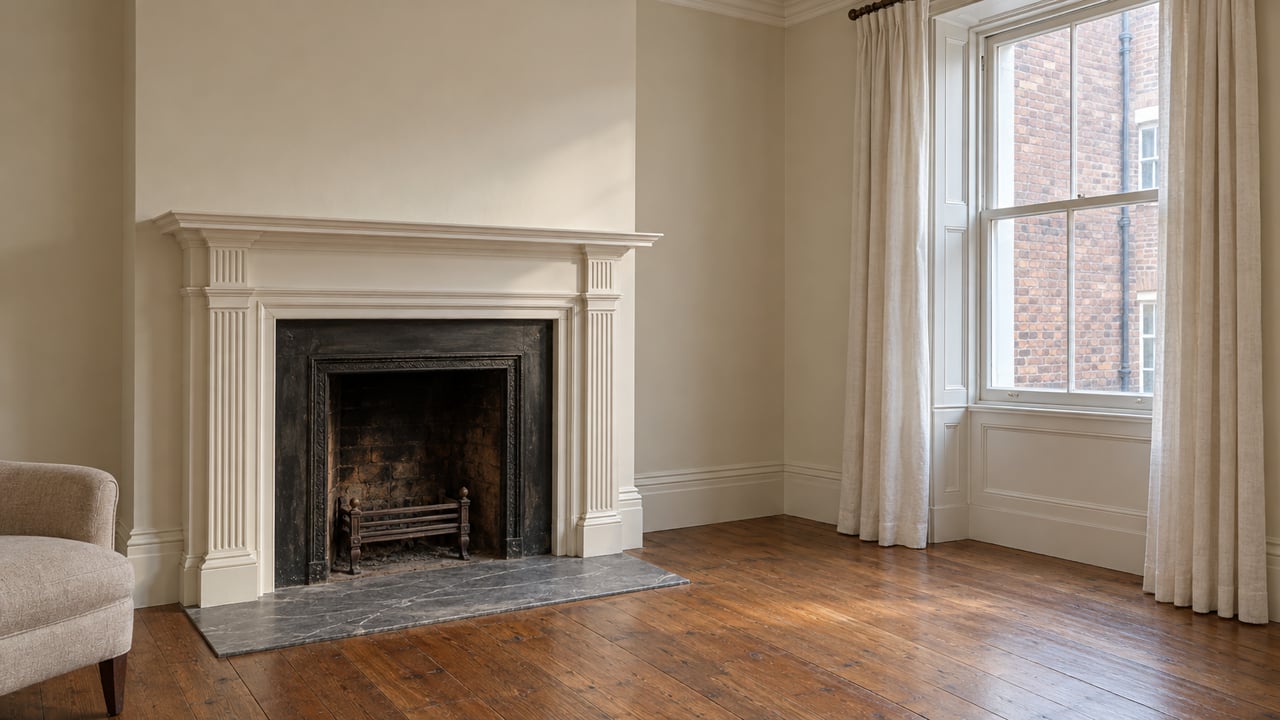
- New units sit behind the old grilles. In most of the formal rooms, the radiators are already hidden in built-in enclosures behind decorative metal grilles. The new fan-coil units go in where the radiators were, behind the same grilles, and new supply registers are set into the window sills.
- Some radiators stay, for show. In the kitchen, the exhibition gallery, the store room and parts of the ground floor, the radiators remain but are disconnected and capped. Heating and cooling in those rooms will come from ceiling units or ducted fan coils.
- The machinery goes on the roof. Two new rooftop heat-pump units are planned, one on each roof, with refrigerant shutoff valves in small rooftop enclosures the documents call "doghouses."
- Fresh air comes through the lightwells. An energy-recovery ventilator in the basement will take in air from the east lightwell and exhaust it through a new louver in an existing lightwell on the front elevation.
- Every opened surface gets fully refinished. Where a wall or ceiling is opened to run refrigerant or electrical lines, the contractor is told to patch it and repaint the whole wall or ceiling, so no patch shows.
The electrical service is being replaced as well, with a new 400-amp main distribution panel and a subpanel on the fourth floor. The two flat roofs are being reroofed under a separate contract, and the equipment rails are to be installed once the concrete deck is exposed.
The roof equipment and the lightwell louver are the only outward signs of the work, and both are placed where few people look.
Approvals, asbestos and a cold winter
Because the site is a National Historic Landmark inside a locally designated historic district, the Trust notes that the project needs approval from both the DC Historic Preservation Office and the Commission of Fine Arts. The Trust has said it will obtain both and pay the permitting fees.
There is also a material problem. During riser repairs in 2021, crews found friable asbestos insulation wrapped around the existing supply line. Contractors were told to assume that any wall they open will expose more, and to include an abatement allowance in their bids. The plan is to stay away from the old steam riser locations and keep the existing asbestos sealed in place wherever that is reasonable.
The work also runs through the winter. The old boiler will be gone and the new system won't be running yet, so the contractor has to supply temporary heat for the whole job.
The collections are handled separately. The museum says staff are documenting, photographing, cataloging, conserving, packing and relocating thousands of artifacts and archival materials before construction starts. The Trust is also bringing in an art handler to move or protect objects, and the contractor is responsible for protecting floors and walls wherever work takes place.
The July schedule planned for construction to start November 16, with substantial completion on March 19, 2027. The public closure runs through April 1. The museum is still raising philanthropic support for the project and has not published a total cost.
The rooms still open this season
The Wilson House will be closed until spring, but the historic interiors and exhibitions around it are open, some through the winter and some only for the next few weeks. The closest match is another house tour. Anderson House, home of the Society of the Cincinnati on Massachusetts Avenue, includes a guided tour of the house and entry to its changing exhibition gallery with general admission. Its current exhibition, Voices of Revolution, looks at the many people and battlefields of the Revolutionary War and runs through January 10, 2027. On January 1 Anderson House switches to winter hours, Wednesday through Sunday, so the exhibition's final days are on that shorter schedule.
| Venue | What's on | Through | Visiting |
|---|---|---|---|
| Anderson House | Voices of Revolution plus guided house tour | Jan. 10, 2027 | Tue–Sat 10–4, Sun noon–4 through Dec. 31; $12 adults, $9 D.C. residents with ID |
| The Phillips Collection | Avery, Gottlieb & Rothko: By the Sea | Jan. 24, 2027 | Tue–Sat 10–5, Sun 11–5; $20 adults, free 18 and under |
| Mexican Cultural Institute | Images of Mexico: Myths, Rites, And Arts | Jan. 9, 2027 | Free; Mon–Fri 10–6, Sat noon–4 |
| Mexican Cultural Institute | Mientras las plantas crecían: el jardín de los recuerdos, Regina Escobedo | Jan. 9, 2027 | Free; closed Sundays |
| Korean Cultural Center | Haenyeo: The Breath of Jeju and Hanji: Embracing Color | Nov. 20, 2026 | No RSVP needed during regular hours |
| Heurich House Museum | One-hour guided historic-house tours | Booking calendar through Nov. 15 | Selected dates, $15 general ticket |
| O Museum in the Mansion | Howl at The Moon Halloween pop-up | Nov. 1, 2026 | $55 ticket |
Heurich House is also tour-only. Its booking calendar lists one-hour guided visits on selected dates through November 15, and the house is not open for walk-ins.
At the Phillips, the new exhibition opened October 24, so the museum's temporary galleries are full again for the winter. Tomorrow the Sun Will Rise closed September 20, and the permanent collection stays on view. Members get the first hour on Sundays, from 10 to 11 a.m.
Since October 22, the Mexican Cultural Institute has had two free shows running at once. Images of Mexico opened October 13 with 40 works chosen through a university open call. Regina Escobedo's exhibition opened October 22. Small groups can visit without a reservation.
The two shows at the Korean Cultural Center close sooner. Hanji: Embracing Color shows Lee Seung-chul's work in traditional Korean paper and natural dyes, and both exhibitions end November 20. Howl at The Moon at O Museum in the Mansion runs only through Sunday, November 1.
When the doors reopen
By the Trust's own planning, a visitor who walks into the Wilson House next spring should see the same grilles, the same window sills and the same plaster they saw last summer. The difference will be in the air. A house that has gone more than a century without cooling or mechanical ventilation will hold a steady temperature and humidity for the first time, and its wood, textiles, paper and paintings will be kept in the stable conditions the museum says they need. Any patch you can find will be a sign the work fell short. The museum's notice says the house is closed through April 1 and will reopen in spring 2027, without giving a date.
Many century-old houses in Northwest Washington have the same problem: original radiators, decorative grilles, and rooms built before air conditioning existed. Michael Rankin has restored 17 historic properties and follows projects like this one closely, because the same choices about where equipment goes, what stays visible and what gets fully refinished shape what a historic house is worth over the long term. If you're weighing how to modernize a house like that, or how a buyer might view systems that were brought up to date without disturbing the original fabric, Michael Rankin is available to talk it through. Book an Appointment.