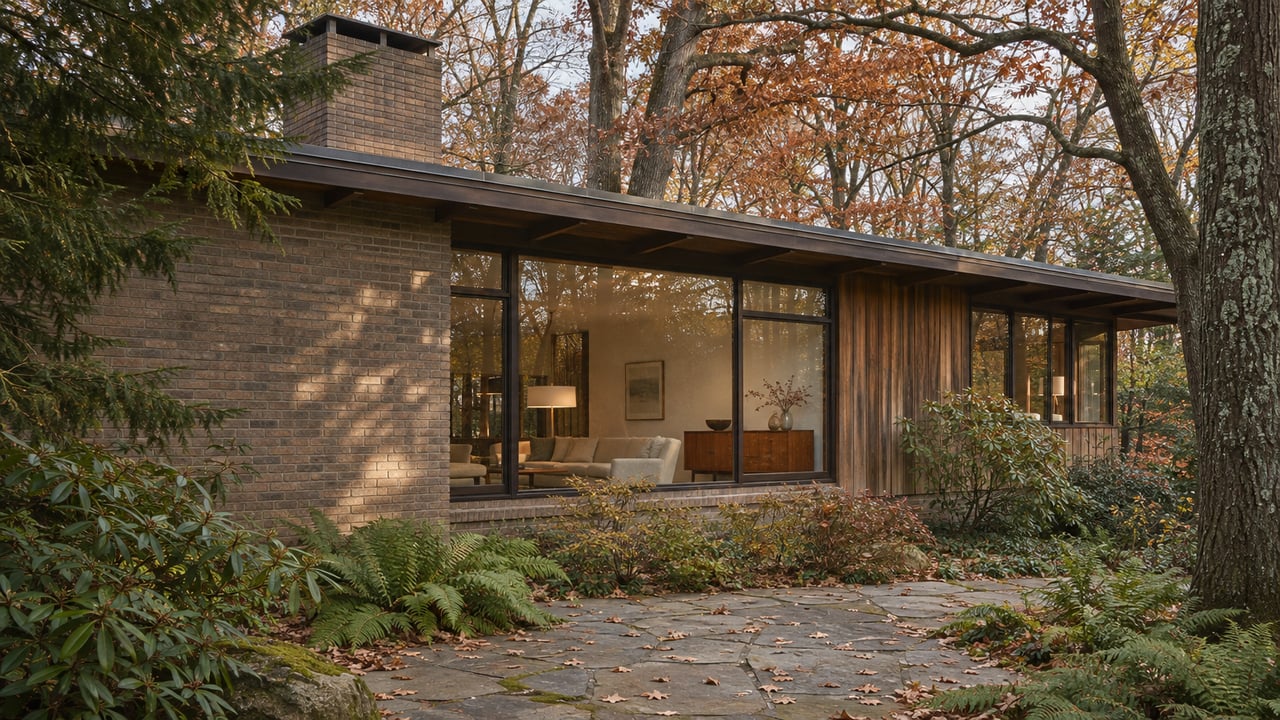
Economist Alice Rivlin once lived in a modest Forest Hills house built in 1956, with one story above a basement. The Washington Post reported that Coba Properties bought it in 2022, added two stories and renovated the interior and the exterior, and the Post's photographs show that the result still reads as mid-century modern. A one-story house became a three-story house on the same lot.
Anyone who wants a modern house in Forest Hills should start from that example. Many of these houses were built as low, glassy pavilions on sloped, wooded land, and the larger houses that have been added on, rebuilt and sold nearby set the prices that sellers use as reference. A buyer who wants the 1960s house as its architect designed it is bidding against buyers who plan to make it bigger.
A neighborhood built one commission at a time
Forest Hills grew piecemeal. The DC Historic Preservation Office's material, published through the DC Preservation League's historic sites project, says individual owners commissioned custom houses on large lots along the Rock Creek Park edge. It counts more than 50 mid-century modern houses in the neighborhood and singles out at least a dozen. The online Mid-Century Neighborhoods Tour dates most of them to the late 1950s and 1960s. The DC Office of Planning's Ward 3 Heritage Guide places the modernist houses along Audubon Terrace, Fessenden Street and Ellicott Terrace, and it describes the stream valleys, uneven ground and cul-de-sacs that set these houses apart from the rest of Upper Northwest.
The DC Historic Sites entry names the houses worth knowing by address:
- Richard Neutra's Brown House, designed in 1968, at 3005 Audubon Terrace
- Chloethiel Woodard Smith's Bender House, designed in 1962, at 2901 Fessenden Street
- Jean-Pierre Trouchaud's house at 2900 Fessenden Street
- Charles Goodman's house at 2605 Tilden Street
- Joseph Miller's house at 2855 Tilden Street
- Brown & Wright houses at 4525 and 4535 31st Street, 4821 Linnean Avenue and 2838 Chesterfield Place
The same entry notes that Brown & Wright's local work includes broad A-frame forms and a distinctive arched roof. Washingtonian identifies Brown & Wright as the first racially integrated architecture firm in Washington and calls Smith one of the city's most significant modernists. The Neutra house shows the setting at its clearest. The Preservation Office describes it as set into its Rock Creek Park site.
These houses were commissioned on generous lots, and the size of those lots connects the architecture to today's prices.
Three outcomes, each with a Forest Hills address
The neighborhood has a documented example of each thing that can happen to one of these houses after it sells.
The house is rebuilt inside its shell. In 2019, developer Jay Gross renovated 2908 Ellicott Street, a late-1950s house by Daumit & Sargent. The Washington Post reported that the work added steel beams, removed walls to open the plan and eliminated the sunken living room. It kept the steps up to the bedrooms and the rear window wall that opens to the patio. A PoPville listing promotion credited the design to Akseizer Design Group and the construction to Coba, and it said everything except the brick envelope was new. The house was offered at about $2.7 million that March. The original form survived, and the cost of keeping it was nearly complete reconstruction.
The house grows. The Rivlin house is the clearest local case. Its 1956 footprint and character stayed legible while two new floors went on top. An older example of the same approach is at 3005 Audubon Terrace, where architect Heather Willson Cass designed an addition to Neutra's Brown House in the early 1990s. The US Modernist archive describes the house as 4,000 square feet. Both houses show that a careful addition can make a mid-century house larger and still keep what made it worth buying.
The house is replaced. In October 2021, Washingtonian reported that a Forest Hills house by Brown & Wright had been bulldozed and replaced with a 17,000-square-foot limestone villa, then on the market at $12 million. The same article described DC Historic Preservation Office architectural historian Kim Williams's survey of more than 230 mid-century modern addresses across the District. At the time, only two modern residences in DC had been designated: the I.M. Pei-designed Slayton House in Cleveland Park and a Trouchaud house in the Palisades. Williams told Washingtonian, "We want people who really appreciate midcentury-modernism, who really appreciate their house."
In each case, someone bought a small house on a large Forest Hills lot and ended up with a substantially larger house, or the same small house rebuilt at close to new-construction cost. Those results now set the prices that the next modest original house is measured against.
What the land is worth to the next buyer
Recent sales show the price the original houses are measured against. On October 21, 2026, 5148 Linnean Terrace sold for $3 million. It is a recently built contemporary of about 4,710 square feet on a 7,502-square-foot lot. On October 8, 2026, 2733 Chesapeake Street sold for $3.7 million with about 7,055 square feet. Across Upper Northwest, detached houses that sold in the 90 days ending September 30, 2026 had a median price of roughly $1.7 million, about 11 percent higher than a year earlier, across 168 sales.
These sales show how the comparison works. Newer houses of roughly five to seven thousand square feet in Forest Hills have recently sold for $3 million or more, and the original mid-century houses are usually much smaller. A buyer who plans to renovate, add on or rebuild starts from a finished value like the Linnean Terrace or Chesapeake Street price and subtracts the cost of the work. That calculation, more than the house's architectural merit, tends to set the price an unrenovated original house can command. Renovated originals fall between the two. The Washington Post reported in March 2025 that 2828 Brandywine Street, a 1952 Forest Hills house updated with recent renovations, was offered at $2.425 million.
The citywide market is not slowing that calculation. In October 2026, Washington, DC recorded 462 closed sales across all home types, 6.9 percent more than in October 2025. The median sale price was $699,500, up 3.6 percent, and the median home sold in 18 days, according to the Greater Capital Area Association of Realtors' October report. Active listings rose 4.3 percent over the same period to 3,070. Those are District-wide figures, and a Forest Hills house trades at several times the median. The pace still matters. A buyer who wants an original house has little time to decide before a buyer with a rebuild plan makes an offer.
What keeping the house actually involves
A buyer who wants the house largely as designed is choosing a specific kind of renovation. Designers who work on mid-century houses in Forest Hills describe updating the kitchens, baths, mechanical systems, insulation and windows while keeping the flat roofs, large areas of glass, open plans and natural materials that define the houses. They also name two site conditions that shape any project here, steep grades and limited access for construction equipment.
Architect Travis Price told Forest Hills Connection in 2013 that he had built or renovated several houses in the neighborhood. He said work on these hillsides requires care with steep slopes and with keeping trees. His own house has a copper wall facing the street and a glass wall facing the woods. That arrangement is the Forest Hills modern house in its basic form: closed to the street and open to the trees behind it.
The trees and slopes are much of what a buyer of an original house is paying for, and they make any construction project slower and more expensive. Forest Hills Connection lists public access to the park and its trails at Albemarle Street, Broad Branch Road, Windom Place and both ends of Audubon Terrace. The neighborhood's houses sit close to these valleys, and some are older than the modernists. At 3020 Albemarle Street, a 1924 house by Horace Whittier Peaslee stands beside the Soapstone Valley Trail on land that slopes toward the valley. On a lot like that, the most valuable feature is the view into the valley, and adding floors or footprint can change that view.
Reading a Forest Hills modern listing
A listing for one of these houses calls for questions that go beyond the photographs. Start with the architect and the year, because a named designer such as Smith, Goodman, Neutra, Trouchaud or Brown & Wright changes both the buyers who will compete and the house's value at resale. Then ask what has already been done. A house that was opened up behind its original brick, as at 2908 Ellicott Street, is a different purchase from one that still has its original systems. Next, look at the site from the street and from the back. The grade, the trees and the route a construction truck would have to take shape what any work on the house will cost.
The last question comes from the local market. If nearby sales of larger houses set the seller's price, a buyer who plans to keep the original house is paying a price that assumes it will be enlarged or replaced, and is choosing not to do either. Some of the best mid-century houses in Washington survive because their buyers made that choice knowingly.
If you are considering one of Forest Hills' architect-designed modern houses, or own one and want to understand how the market is likely to value it, Michael Rankin can help you weigh the house against its lot before you commit. Book an appointment to begin.